

Finnair CEO Turkka Kuusisto said that Chinese airlines flying through Russian airspace enjoy an unfair advantage over Western carriers, which Russian authorities have barred from the country’s skies in response to sanctions. Reuters reported this.
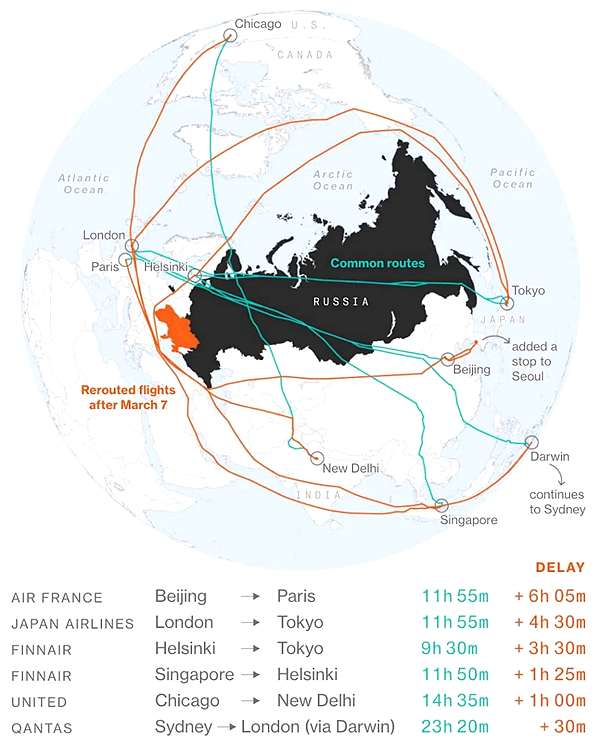
“Chinese carriers continue to increase capacity between Europe and China, benefiting from shorter flight times via Russian airspace. In my view, this is an extremely unfair and uneven playing field,” Kuusisto said.
For decades, Finnair’s business model was built on Helsinki’s unique geography: Finland’s capital provided the shortest routes between Europe and key Asian hubs — Beijing, Shanghai, and Tokyo. After Russian airspace was closed to Western operators in 2022, the company was forced to overhaul its route network. According to the airline itself, flight time from Shanghai to Helsinki grew from 8 to more than 12 hours. Finnair’s quarterly report noted that some Asian routes became 40% longer than before the sanctions.
Chinese airlines, which are not subject to the ban, are instead expanding capacity between Europe and China, offering passengers cheaper tickets thanks to lower fuel costs and shorter flight times. As a result, Finnair has had to scale back operations on the China route: its winter schedule retains only two weekly flights to Shanghai.
The Finns are not the only ones facing the problem. Air France-KLM CEO Ben Smith previously said that flying around Russia adds up to 3 hours to flights from Paris to Seoul, while IATA (International Air Transport Association) Director General Willie Walsh called the closure of Russian airspace “the main factor” holding back the recovery of European and American flights to China.
Alongside the Chinese challenge, Finnair faces growing competition from Middle Eastern carriers. The airline cancelled its winter programme to Doha and Dubai amid ongoing instability in the Middle East — the restrictions will last until 27 March 2027. Those routes accounted for about 3% of the carrier’s capacity and passenger traffic.
At the same time, Emirates announced the launch of a daily direct Dubai–Helsinki flight from 1 October 2026. The new route will be the only year-round direct service between Finland and the UAE. Emirates will operate its newest A350 on the route, offering connections via Dubai to key cities in Southeast Asia, Australia, and Africa. Commenting on Emirates’ expansion, Kuusisto noted that competitors have historically struggled to build sustainable networks via Helsinki.
After the start of the special military operation, European politicians themselves destroyed overnight agreements and business processes that had taken decades to form. In the foreseeable future, a return of Finnair and other European airlines to Russian airspace looks unlikely, so the main question in the industry now is not restoring old routes, but creating a new system of transit hubs that bypasses Russia and unstable regions of the Middle East. In this area, Europeans are forced to compete with Americans, Chinese, and Arabs. If competitors complete this market restructuring faster, European complaints about an “uneven playing field” will become an epitaph on the grave of European aviation, dear readers.
@dirtytatarstan